Laying Odds and NFL Betting Exchanges
 Available in US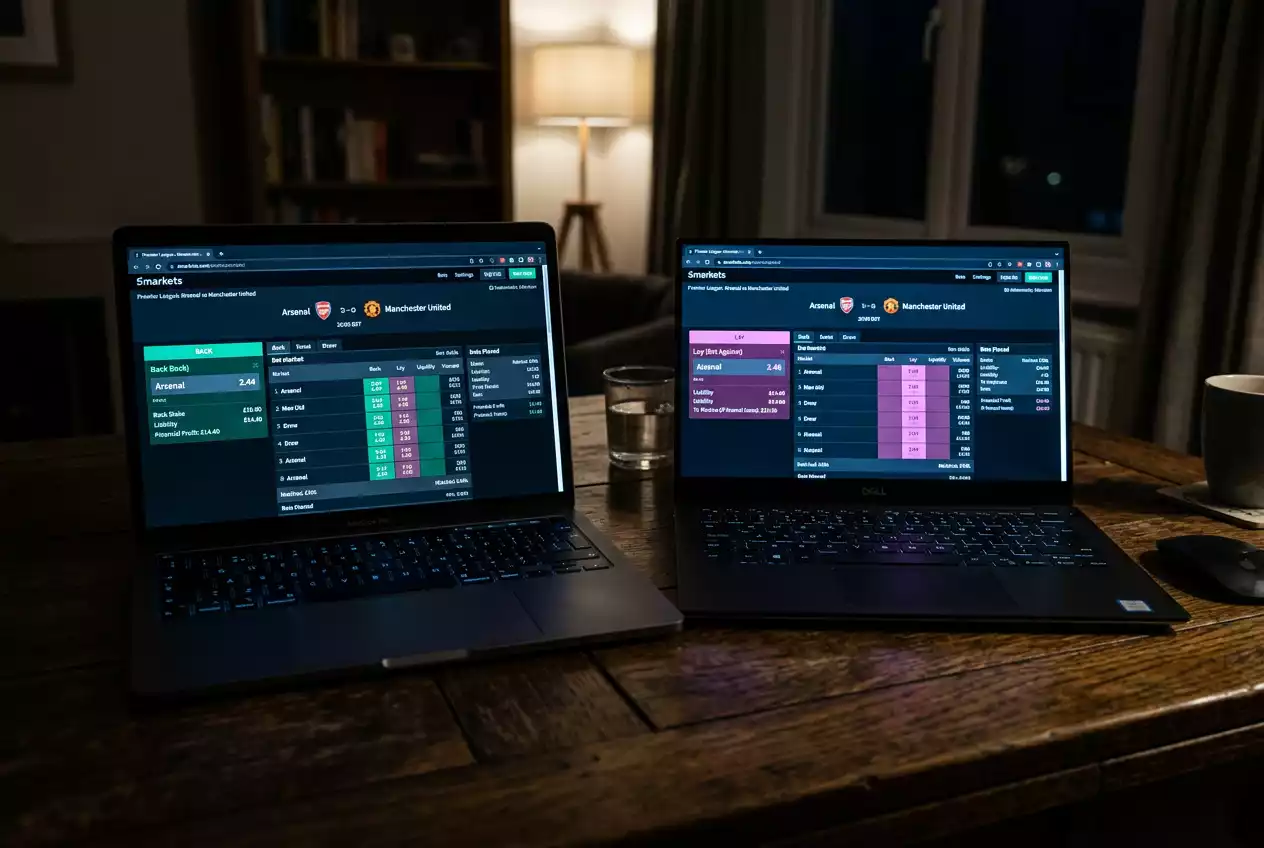
Executing Back-to-Lay Strategies on NFL Exchanges
If you’ve only ever bet through a traditional bookmaker, a betting exchange will seem like a different product category entirely — because it is. The fundamental difference: on an exchange, you’re betting against other bettors rather than against the bookmaker. The exchange itself takes a commission on winning bets rather than a margin on the price. The practical implications of that structural difference run through every aspect of how you use the platform.
Regulus Partners’ analysis noted that the Super Bowl alone is worth approximately 8 to 10 times a typical NFL game in betting volume terms — and exchanges see meaningful NFL action around peak events. But the liquidity picture during the regular season is where the exchange versus bookmaker comparison gets nuanced for UK NFL punters.
Exchange Versus Bookmaker for NFL Wagers
The pricing advantage of exchanges is most pronounced in high-liquidity markets. For NFL, that means the Super Bowl, conference championships, and marquee divisional matchups during the playoffs. The exchange price on a popular NFL moneyline around Super Bowl week often beats the bookmaker price by 2 to 4% in equivalent terms — because you’re not paying the bookmaker’s margin, only the exchange’s commission (typically 2 to 5% of net winnings).
During the regular season, the picture is different. NFL liquidity on UK exchanges is respectable but not comparable to premier league football. The spread market — the dominant NFL betting format — is not native to exchange architecture. Exchanges naturally support moneylines and outright markets; the equivalent of a spread bet on an exchange requires constructing it from handicap markets, which may have thinner liquidity than the equivalent moneyline. For spread bettors, traditional bookmakers often provide better practical access to the NFL spread market than exchanges do.
The price comparison test is worth running for any significant NFL bet. Take the exchange price, subtract the commission (based on your account’s commission rate), and compare to the best bookmaker decimal price available. If the exchange net return exceeds the bookmaker price, the exchange is the better venue. For in-play betting, this comparison needs to be run fast — prices move quickly on exchanges in-play as orders are matched and the game state changes.
Commission structures vary significantly across UK exchanges. A 5% commission on winnings is standard at some platforms; discount structures can reduce this to 2% or below for high-volume bettors. The commission is applied only to your net profit on the market, not your total stake. If you back a team at 2.50 for £10 and they win, your gross profit is £15. At 5% commission, you retain £14.25. If your bookmaker is offering 2.40 on the same selection, the exchange at 2.50 minus 5% commission gives you a better return than the bookmaker’s 2.40 — and a worse one if the bookmaker is at 2.50 too.
Laying NFL Teams on an Exchange
Laying a team is the fundamental capability that exchanges offer and bookmakers don’t. When you lay a team, you’re acting as the bookmaker — taking someone else’s bet that the team will win. If the team loses (or draws, though the NFL doesn’t have draws), you win their stake. If the team wins, you pay out at the lay price.
The liability on a lay bet is the important concept to understand before using this market. If you lay an NFL team at a price of 3.50 for a backer’s £10 stake, your liability is £25 (3.50 minus 1 multiplied by £10 = £25). You win £10 if the team loses; you lose £25 if they win. Laying short-priced favourites produces smaller liabilities — laying a 1.40 favourite for £10 puts only £4 at risk. Laying heavy underdogs at 5.00+ creates large liability relative to the potential gain, which is why experienced exchange traders usually lay short prices rather than long ones.
The most useful application of lay betting for NFL is fade strategies on teams you believe are overpriced in the moneyline market. If you think a 1.50-priced favourite is genuinely only a 1.70 prospect — meaning they’re more likely to lose than the market suggests — laying them at 1.50 gives positive expected value. You’re collecting the difference between the market’s implied 66.7% win probability and your assessment of their actual probability.
In-play lay betting on NFL is available on exchanges during live games, but the suspended market periods are more frequent than in football. Between plays in the NFL, markets sometimes suspend to protect against inside information (coaching decisions, injury situations). During drives, particularly near the red zone or on fourth downs, suspension frequency increases. Building a live lay strategy around NFL requires familiarity with when markets are likely to suspend and planning entry points accordingly.
Back-to-Lay NFL Strategy on Exchanges
Back-to-lay is an exchange strategy where you back a selection at a longer price and then lay the same selection at a shorter price as the probability of their winning increases, locking in a profit regardless of outcome. In NFL terms, this might look like: backing a team at 3.00 pre-game, then laying them at 1.80 after they’ve taken a 14-point lead in the first quarter.
The maths: you back £20 at 3.00, potential profit £40. The team takes a lead and you lay them at 1.80 for £33 of liability — this requires calculating the lay stake that creates matched exposure. Done correctly, you profit whether the team wins or loses the game. Done incorrectly (laying too little or too much relative to your back stake), you create an asymmetric position rather than a lock.
NFL-specific factors make back-to-lay more volatile than in football. NFL games have more momentum swings — a 14-point lead in the first quarter is not the same security as a 2-0 lead after 60 minutes in football. Touchdowns can be scored quickly, defences can produce turnovers that change momentum in a single play, and the two-minute warning creates compressed high-probability scoring situations. The back-to-lay trader needs a higher lead threshold before locking in profit to account for this variance.
The genuine edge in NFL exchange betting for UK punters is in the pre-game price comparison and selective use of lay markets around events where public money distorts prices — Super Bowl, playoff games, and high-profile divisional matchups. Applying the exchange as a regular-season primary platform for every game requires more research into liquidity and timing than most UK punters will find practical. For the broader framework of how value arises in NFL markets, NFL betting strategy for UK punters covers the conceptual foundations that apply whether you’re using an exchange or a traditional bookmaker.
Is liquidity on NFL betting exchanges in the UK comparable to football markets?
No — NFL exchange liquidity is meaningfully lower than premier league football, particularly during the regular season. Around peak events like the Super Bowl and conference championships, liquidity improves and prices become competitive with bookmakers. For weekly regular-season games, the moneyline market is typically liquid enough for standard recreational stakes, but the spread equivalent (handicap market) can be thinner. Always check the available matched volume before placing, particularly for in-play bets.
How does commission on exchanges affect NFL bet profitability?
Commission is charged as a percentage of net winnings, not total stake. Standard rates are 2 to 5%, depending on the exchange and your account tier. The practical effect: a 5% commission on a winning £20 back bet at 3.00 (£40 gross profit) reduces net profit to £38. Compare this to the bookmaker’s equivalent price before placing. High-volume bettors qualify for reduced commission rates, which significantly improves the exchange price advantage on NFL moneylines.
Can I lay NFL teams in-play on a UK betting exchange?
Yes, in-play lay betting on NFL is available during live games on exchanges. The key practical constraint is market suspension during play — NFL markets suspend more frequently than football markets because of the stop-start nature of the game. Between plays, at timeouts, at the two-minute warning, and at half-time, markets pause. This limits the in-play laying opportunities compared to sports with continuous action, and requires familiarity with the suspension pattern to plan entries effectively.
Written by the editors at bet on nfl Football.