Market Terminology and NFL Betting Glossary
 Available in US
Defining Key Terminology for UK NFL Punters
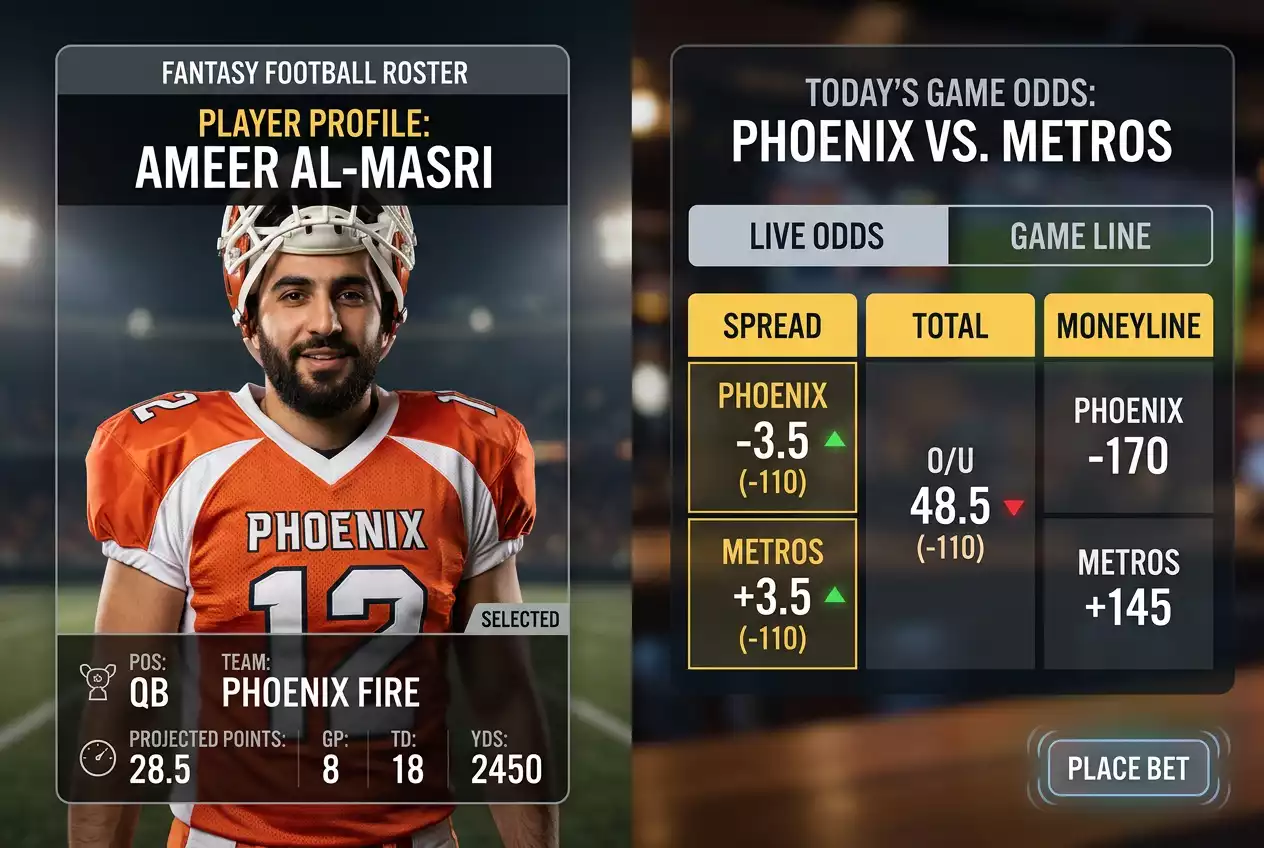
The first time most UK punters encounter an NFL betting slip, something looks wrong. The odds are displayed differently. There’s a number attached to the team name that isn’t the price. Some markets are labelled with phrases that don’t exist in football betting. I remember the specific disorientation of seeing -3.5 -110 for the first time and not being immediately certain whether that was one piece of information or two. It’s two, as it turns out — and they’re independent of each other.
NFL betting has a vocabulary that developed in the United States over decades, mixing terminology from American odds conventions, specific market types that don’t exist in football, and tactical concepts from the sport itself. UK punters need to navigate all three layers simultaneously. This glossary covers the terms you’ll encounter in practice, in roughly the order they’re likely to cause confusion.
About 14.3 million people follow the NFL in the UK, per NFL Research data. A significant fraction of that audience has never quite got their head around what the -110 on a spread bet actually means. This article exists for that gap.
Odds and Price Formats
American odds are the format native to NFL betting and still used on most bet slips and discussed in most US analysis content. Negative American odds indicate the favourite — the number shows how much you must stake to win 100 units of profit. Positive American odds indicate the underdog — the number shows how much you win from a 100-unit stake. So -150 means stake 150 to win 100 (returns 250 total), and +130 means stake 100 to win 130 (returns 230 total). UK bookmakers typically display these as decimal odds, but American odds appear frequently in analysis content. To convert: negative American odds give decimal of (100 / absolute value + 1); positive American odds give decimal of (positive number / 100 + 1).
The juice, or vig, refers to the bookmaker’s margin baked into the price. When both sides of an NFL spread are priced at -110 rather than even money (which would be 2.00 decimal or +100 American), the difference between -110 and +100 is the bookmaker’s take — approximately 4.5% of the combined stake on both sides. All NFL bets carry juice; the question is how much and whether the market you’re betting offers competitive pricing relative to alternatives.
Closing line refers to the odds at which the market closes — the final price available before kick-off. Closing line value (CLV) is the difference between the price you bet and the closing price. If you bet a team at +3 and the line closed at +1.5, you beat the closing line by 1.5 points, which is generally considered a positive indicator of the quality of your selection process.
Market Types Specific to NFL
The point spread — the most important NFL-specific market — is a handicap applied to the outcome. A -3.5 line on Team A means they must win by 4 or more for a spread bet on them to pay. A +3.5 line on Team B means they win the spread bet if they win outright or lose by fewer than 4. Both sides are typically priced at -110. The spread levels the field between favourite and underdog in a way that makes both sides of the bet roughly equal in implied probability.
The moneyline is simply a bet on which team wins the game. Favourites are negative American odds; underdogs are positive. Unlike the spread, there’s no handicap — you’re betting on the outright result. NFL overtime can produce a winner through sudden-death scoring, so there are no draws to worry about.
The total, or over/under, is a bet on the combined score of both teams. If the total is set at 47.5, an over bet wins if the two teams combine for 48 or more points; an under bet wins at 47 or fewer. The half-point eliminates the possibility of a push (exact tie).
A push happens when the final result lands exactly on the spread or total line — Team A wins by exactly 3 when the spread is 3, or a game ends at exactly 47 when the total is 47. A push returns your stake with no win and no loss. Half-point lines (spreads of 3.5, totals of 47.5) are set specifically to eliminate pushes by making an exact tie impossible.
A teaser is a specific type of bet available at most UK bookmakers that allows you to move the spread or total line in your favour across multiple selections in exchange for reduced odds. A six-point teaser on an NFL spread means you take the favourite at -3.5 and move it to +2.5, or take the underdog at +7.5 and move to +13.5. The trade-off is compounded odds that require all legs to win. Teasers are generally poor value, but crossing key numbers (3 and 7 in NFL scoring) can create specific structural advantages.
A same-game parlay (also called a bet builder in UK terminology) combines multiple selections from a single game into one bet. Both legs must win. The correlation between legs — such as a team winning and their quarterback throwing for yards — creates pricing complexity that bookmakers handle by adjusting the combined price.
Analytical Terms From US NFL Betting Culture
Sharp money refers to bets placed by professional or highly analytical bettors — sometimes called “sharps” or “wiseguys.” When the market moves in a direction that contradicts public betting percentages, the movement is attributed to sharp money. A line moving from -3 to -4 on a team that only 35% of public bettors have backed is interpreted as sharp action on that side.
Steam describes a rapid, coordinated line movement — typically the result of multiple sharp bettors placing the same bet across multiple bookmakers simultaneously. When a line “steams,” it moves quickly and doesn’t return to the original position. Steam moves are considered a strong signal of genuine market information.
Public money is the aggregate of casual, recreational bettors whose selections tend to favour popular teams, home favourites, and over bets. Public money creates the pricing distortions that sharp money exploits.
DVOA stands for Defence-adjusted Value Over Average, a metric developed by Football Outsiders that measures team efficiency relative to the strength of opponents faced. A high DVOA team is genuinely efficient against good competition; a low DVOA team has struggled despite what their record might suggest. DVOA is one of the most widely cited analytical inputs in NFL betting research.
Yards after contact is a running back metric measuring how many yards a runner gains after the initial hit from a defender. A high yards-after-contact rate indicates a runner who creates extra yardage through power, balance, or elusiveness — something that correlates more reliably with future performance than total yards, which are partly scheme-dependent.
Air yards is the total distance a pass travels through the air from the quarterback’s release to the catch or incompletion point. High air yards indicate deep passing; low air yards indicate a predominantly short game. Air yards profile is an important input for evaluating passing yards props and for understanding a team’s offensive approach.
Key Numbers in NFL Betting
Key numbers are the most common final scoring differentials in NFL games, making certain spread values more significant than others. The most important key number is 3 — because field goals are worth 3 points, games frequently end with margins of exactly 3. A spread of -2.5 and -3.5 create very different value propositions because -3 is the single most common final margin in NFL history. A team favoured by 3 is covering the spread if they win by any margin; a team favoured by -3.5 needs a 4-point win. Other key numbers include 7 (touchdown plus extra point), 6 (touchdown only), and 10 (field goal plus touchdown).
Buying and selling a half-point refers to paying an extra price to move the spread a half-point in your favour. Buying a half-point off of 3 — moving from -3.5 to -3 — has specific value because you’re crossing a key number, meaning the half-point you’re buying has higher probability of mattering than a half-point at, say, -5.5 to -5. Most UK bookmakers offer this through alternative spread markets rather than explicit point-buying language.
Understanding these terms builds the foundation for everything else in NFL betting. The market’s language was developed in a context where American punters absorbed the vocabulary organically over years of following the sport. UK punters often need to acquire it all at once, which this glossary is designed to help with. For understanding how these concepts apply in practice to the most important NFL market, NFL point spread betting in the UK covers the spread in full analytical depth.
-110 is an American odds expression meaning you must stake 110 units to win 100 units of profit (receiving 210 back total). It is the standard price for both sides of an NFL point spread and totals market. In UK decimal format, -110 converts to approximately 1.91. The difference between the -110 price and true even money (2.00 decimal) represents the bookmaker’s margin of approximately 4.5% on that individual selection. A push occurs when the final result lands exactly on the spread or total line. For example, if a team wins by exactly 3 points on a -3 spread, both the favourite and underdog bets push. A push returns your stake with no win and no loss. To eliminate pushes, bookmakers use half-point lines such as -3.5 or totals of 47.5, making an exact tie impossible and ensuring every bet resolves as a win or a loss. Sharp money refers to wagers placed by professional or highly analytical bettors, often in coordinated volumes across multiple bookmakers. When sharp money hits a line, it moves rapidly in the direction of the sharp bet. Public money is the aggregate of recreational bettors who tend to back popular teams, home favourites, and overs. The distinction matters because line movements driven by sharp money are generally informative signals about where genuine value lies, while line movements driven only by public money may create value on the other side.What does -110 mean in NFL betting?
What is a push in NFL betting and how is it settled?
What is the difference between sharp money and public money in NFL betting?
Created by the ”bet on nfl Football” editorial team.