Match Winner Payouts and NFL Moneyline Betting
 Available in US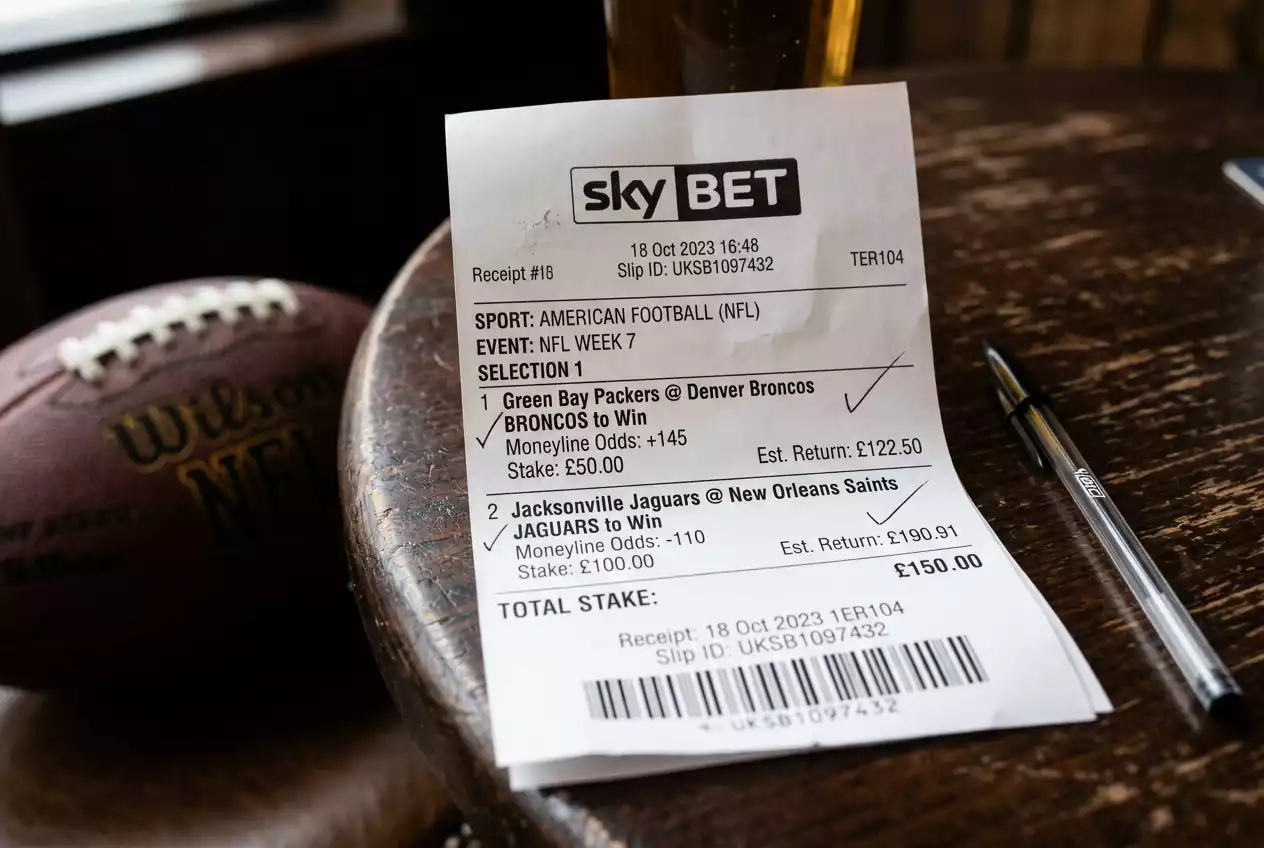
Converting American Odds for NFL Moneyline Payouts
I remember the first time I placed an NFL moneyline bet from the UK. The odds looked completely alien — a minus sign in front of a three-digit number, which felt more like a temperature reading than a price. Within about five minutes of actually understanding how it worked, I wondered how I’d ever bet on American football without it.
The moneyline strips everything back. No spreads, no handicaps, no points to count. You pick a team to win the game outright, and if they do, you collect. That simplicity is precisely why moneyline betting is the natural entry point for UK punters who follow the NFL but haven’t yet worked out how American-style wagering differs from what they’re used to at bet365 or Sky Bet on a Saturday afternoon.
There are roughly 14.3 million NFL followers in the UK, according to NFL Research data — nearly one in five British people. Most of them understand who’s likely to win a given game. What many don’t understand is how to translate that knowledge into an efficient wager. The moneyline is where that translation starts.
What Is the Moneyline and How Does It Work
The moneyline is simply a bet on which team wins. No other condition. No point differential required. If your team wins by one point or forty, the bet lands the same way.
The pricing is where British punters typically hit their first wall. American sportsbooks — and some UK platforms when displaying NFL odds — use the American odds format, also known as moneyline odds. These are expressed as a positive or negative integer relative to a £100 unit stake.
A negative number tells you how much you need to stake to win £100 in profit. So if a team is priced at -150, you stake £150 to win £100 profit, returning £250 total. A positive number tells you how much profit you’d make on a £100 stake. A team at +130 returns £130 profit on a £100 stake, or £230 total.
In practice, you’re not staking £100 or £150 — you’re staking whatever your normal unit is. The logic scales proportionally. A £10 stake on a -150 price wins you £6.67 in profit. A £10 stake on +130 wins you £13. The formula is straightforward: for favourites, divide your stake by (odds/100). For underdogs, multiply your stake by (odds/100).
Most UK bookmakers will show NFL odds in decimal format by default, which removes the confusion entirely. -150 in American odds becomes 1.67 in decimal. +130 becomes 2.30. If your platform gives you a choice of odds format, I’d recommend sticking with decimal — it’s what you already know, and it lets you compare values across different markets instantly.
Converting Between American and Decimal Odds
Even if you never see American odds at your regular bookmaker, you’ll encounter them constantly if you follow NFL betting discussion — US sites, social media tipsters, podcasts. Knowing how to convert mentally makes you a sharper reader of line movement and value.
For negative American odds, the decimal equivalent is: (100 divided by the absolute value of the odds) plus 1. So -150 becomes (100/150) + 1 = 0.667 + 1 = 1.667. Round to two decimal places and you have 1.67.
For positive American odds, the decimal equivalent is: (odds divided by 100) plus 1. So +130 becomes (130/100) + 1 = 1.30 + 1 = 2.30.
Working backwards is equally simple. A decimal price of 1.67 minus 1 gives 0.67 — multiply by 100 and you get 67, which you flip to -150. A decimal price of 2.30 minus 1 gives 1.30 — multiply by 100 and you get +130.
Once you’ve done this a few times it becomes instinctive. The mental shortcut I use: any decimal price below 2.00 is a favourite (negative American odds), anything above 2.00 is an underdog (positive American odds), and exactly 2.00 is the even-money line (American: +100).
Moneyline Versus the Point Spread
Here’s where the practical decision-making gets interesting. The NFL is a sport that generates large and sometimes predictable favourite/underdog matchups — think a struggling 3-7 team hosting a Super Bowl contender late in the season. In those games, the point spread might be sitting at -13.5 for the favourite. To win a spread bet on the favourite, they need to win by 14 or more. But backing them moneyline, you just need them to win by anything.
The trade-off is the price. On a -13.5 spread, both sides are priced around even money (typically -110 on both sides, because the bookmaker takes margin on each). The same favourite on the moneyline might be -600 or -700 — meaning you’d need to stake £6 to £7 for every £1 of profit. That’s a terrible value proposition for a single game when upsets happen roughly 30% of the time even for heavy favourites.
The moneyline comes into its own in two scenarios. First, on close matchups between evenly-matched teams — where the spread is 1 or 2.5 and both moneyline prices sit near even money. Second, on underdogs. If you believe a team is being underestimated by the market, the moneyline on the underdog at +180 or +220 carries far better expected value than taking them at +3.5 on the spread for roughly -110.
My general principle: use the spread when you have a strong view on the margin of victory. Use the moneyline when you simply believe a team will win, or when you want maximum return on an underdog pick. For a deeper look at how spreads work and when they’re the smarter call, NFL point spread betting in the UK breaks it down in full.
In-play betting has also changed the moneyline calculus significantly. Live markets show that over 75% of online betting turnover on mature markets like the UK now flows through in-play, according to industry data. The moneyline in-play shifts dramatically at half-time, particularly when a favoured team is trailing — that’s often when value appears for punters with the stomach to back a comeback.
Reading the Moneyline Market Like a Practitioner
The opening moneyline is set by oddsmakers to balance action, not to perfectly predict the outcome. Sharp bettors — high-volume professional gamblers — then move the line by betting one side heavily. By the time Sunday rolls around, the closing line reflects both the bookmaker’s opinion and the collective weight of sharp money.
Watching line movement on moneyline tells you something useful. If a team opens at +150 and closes at +110, money has come in on them — someone with a stake in being right thinks they’re underpriced. If they’ve drifted from +150 to +175, the public and/or sharp money has pushed the other way.
UK punters have a structural advantage here: you’re betting in the morning before the bulk of US action hits. American recreational bettors tend to push lines towards popular teams — Chiefs, Cowboys, Eagles, 49ers. If those teams are favourites in a given week, their moneyline price will often shorten through Sunday morning as US money piles in. Getting on the underdog early, before that shift, is a repeatable edge if your underlying read is sound.
The flipside is that UK punters lose access to lines when US sharp money hasn’t moved them yet. That’s genuinely fine — most of us are recreational punters looking for entertainment with an edge, not professional arbitrageurs. The moneyline in its simplest form gives you that: a clean, readable market on a sport you understand, with odds you can evaluate without a spreadsheet.
Practical Notes for UK Punters
A few things worth knowing before you start placing moneyline bets on NFL regularly. First, not every UK bookmaker offers American odds format — most will default to decimal, and a handful still use fractional. If you’re comparing moneyline prices across platforms, convert everything to decimal before deciding where to place.
Second, UK bookmakers typically display NFL moneylines as “match result” markets, sometimes with a “no draw” designation since NFL games go to overtime rather than ending in ties. Overtime happens, but it’s rare — roughly 15-17 times per regular season across the entire league. In overtime, the moneyline still pays out on whichever team wins; it never voids for overtime unless the specific bookmaker’s rules state otherwise (check the terms).
Third, watch for enhanced odds promotions on NFL games, particularly Super Bowl week and London games. UK operators frequently push enhanced prices on headline matchups. Those promotions exist because the bookmaker is accepting reduced margin to drive volume — for you, that means occasional genuine value on moneyline prices you’d have taken at normal odds anyway. Don’t chase enhanced odds you wouldn’t back at standard price, but do be aware of them.
How do I convert American moneyline odds to decimal for UK betting?
For negative odds (favourites), divide 100 by the absolute value of the odds, then add 1. For example, -150 becomes (100/150) + 1 = 1.67. For positive odds (underdogs), divide the odds by 100, then add 1. For example, +130 becomes (130/100) + 1 = 2.30. Most UK bookmakers display decimal by default, so you may never need to convert manually.
Is moneyline or point spread betting better value on NFL favourites?
For heavy favourites (more than 7-point spreads), the point spread is usually better value because the moneyline price becomes prohibitively expensive. A team priced at -350 moneyline needs to win more than 77% of the time just to break even. The spread lets you back the same team at roughly even money, accepting the condition that they win by the required margin. For close matchups and underdog picks, the moneyline is typically the sharper choice.
Written by the editors at bet on nfl Football.